What is a break board?
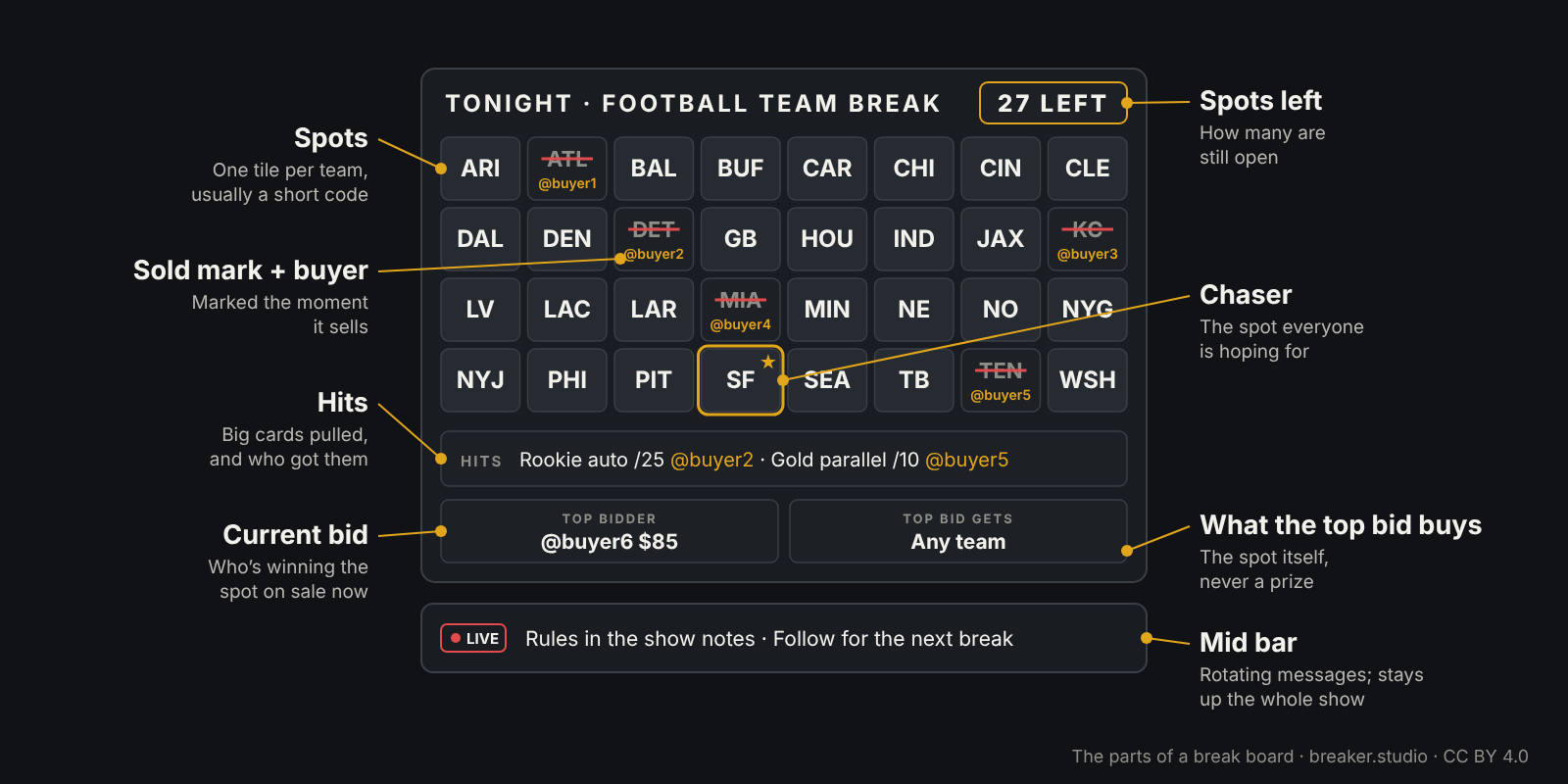
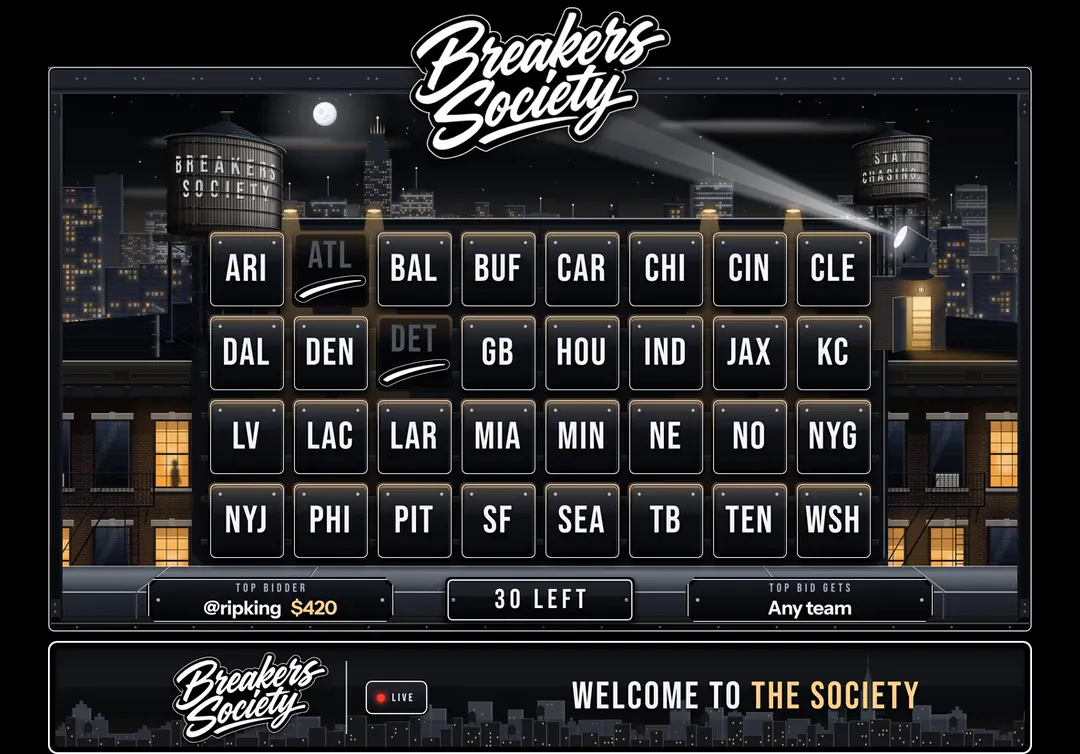
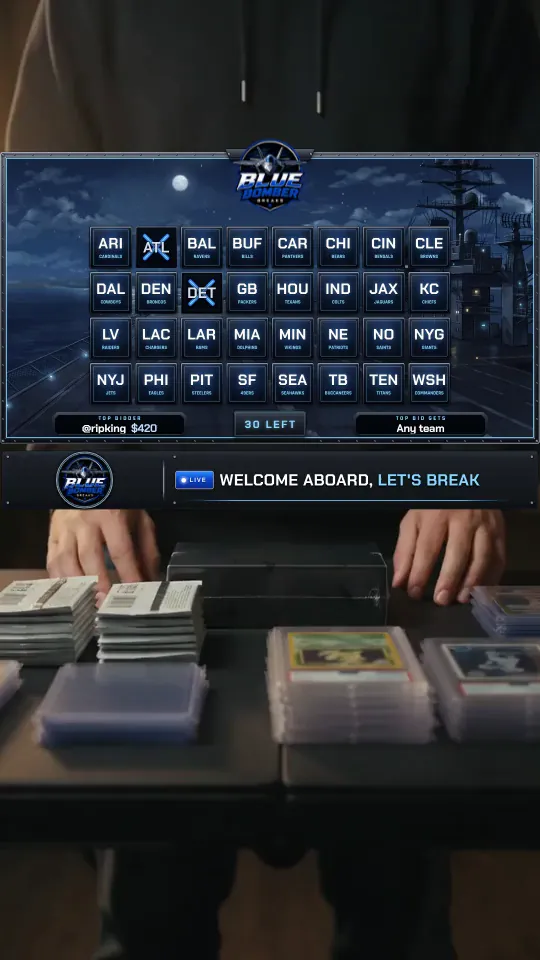
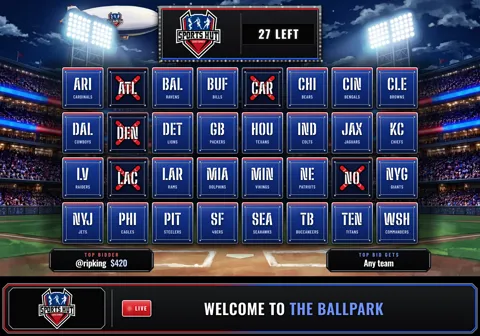
A break board, also called a breaker board, is the on-screen graphic a card breaker shows during a live break on Whatnot, eBay Live or TikTok Shop. It lists every spot in the break, usually the teams, and marks each one with the buyer’s name as it sells, so viewers can see which teams are still open and how many spots are left. Designers also sell them as break overlays or Whatnot scoreboards. Many run from streaming software such as OBS, while some breakers use a hand-drawn whiteboard on camera instead.
By Michael at BreakerStudio · Updated
What does a break board do?
In a card break, buyers purchase spots, usually teams, and get the cards for their spot when the seller opens the product live (card breaking glossary). A break moves fast: spots sell one after another, often at auction, and new viewers join halfway through. They’re watching the video, not opening the spot list, so without a board the seller ends up reading the list out while chat asks what’s still open. A break board does three jobs:
- It shows what’s available. Every open team is on screen, so someone who just joined can pick what to bid on without asking.
- It shows what’s left. Sold spots carry the buyer’s name and a count shows how many remain, so everyone can see how close the break is to filling.
- It makes the show more interactive. Buyers see their name go up the moment they win, the count drops, the last spot gets called out, and the hits go up as they’re pulled.
Do you need a break board on Whatnot?
No, not to start. Whatnot’s Breaks feature already gives buyers a spot list in the app and tracks who bought each spot (Whatnot: Breaks feature), and a whiteboard or printed team sheet on camera works too. A break board puts the break on your video, which starts to pay off when:
- chat keeps asking what’s open, and you’re reading the list out between sales;
- you run several breaks a night and want each one set up in seconds;
- you want the break to play out on the stream itself: names going up, the count dropping, the last spot called out;
- you want your stream recognizable at a glance.
To lay a board over your camera you need streaming software such as OBS on a computer (how to set up OBS for Whatnot).
What’s on a break board?
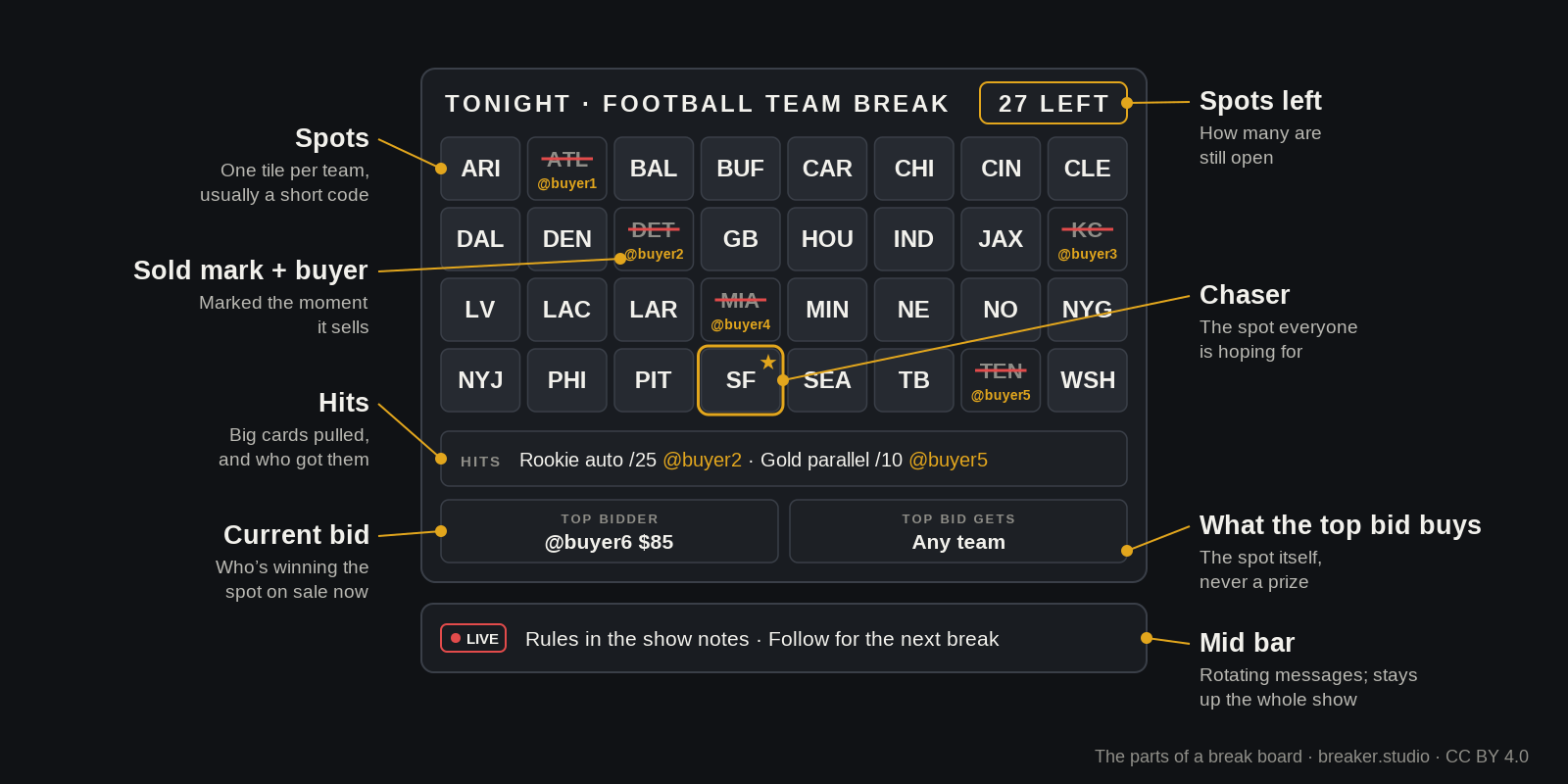
A break board shows every spot in the break, usually as team codes, with each sold spot marked with the buyer’s username and a count of spots left. Many also show the current bid, the chasers, the hits as they’re pulled, and a mid bar of rotating messages under the board.
| Part | What it shows |
|---|---|
| Spots | One tile for each team, division, player or number in the break: usually a short team code (PHI, LAD) or the team name, sometimes with a picture for each team. In Pick Your Team breaks, some boards show each team’s price on its tile. |
| Sold marks and buyers | Each spot is marked the moment it sells, with the buyer’s username on it. |
| Spots left | How many spots are still open. Some boards call out the last open spot by name. |
| Current bid | Who’s winning the spot on sale now, the top bid, and in some formats what the winning bid buys (for example, any team). The Whatnot app shows the live bid too; the board puts it where everyone is already looking. |
| Mid bar | A strip across the middle of the screen, under the board, that rotates messages: the break name, your rules, shipping, a follow prompt, your socials or a QR code. Where a stream has one, it usually stays up for the whole show, while you sell and while you rip, even when the board is hidden. |
| Chasers | The spots or cards everyone is hoping for, marked so they stand out. |
| Hits | The big cards as they come out of the packs, and who got them. |
| Board animations | Short animations on the board itself when something happens: a spot selling, one spot left, the break filling up, a big hit. |
Graphics only, or a board with a control panel?
Some break boards are graphics only: a designed image or template where you mark sold spots by hand, by editing layers in OBS or typing into the board through OBS’s Interact window. Others come with a control panel, a separate page on your computer, phone or tablet where one click or a typed name updates the board on stream. The control panel is what keeps a board fast enough for a busy break, so ask which one you’re buying.
Break animations and stream scenes
Beyond the board itself, many breakers play break animations: short clips that play over the board for a sales moment inside a break, like Stash or Pass, See 2 Pick 1, Pick Your Team or Live at $1. Whatnot lists these as formats; on stream they’re played as break animations. They mark the moment; they never decide what a buyer gets. Stream scenes are full-screen layouts for before the show, between breaks and at the end, never during a break. As of November 2026, Whatnot’s Card Breaks Policy requires the full display of a break, including the product, tools and your hands, to stay onscreen from the sale of an item to the end of the break, so animations belong over the board, never over the cards.
More in break animations and stream scenes for breakers.
How a break board works during a live break
Most on-screen boards are a layer in OBS, or similar streaming software, over your camera. With most software boards you don’t edit the graphic itself during a show; you update it from a control panel. Some tools run the panel on the streaming computer, others on a phone or second screen, so a moderator can run the board while you rip.
In a Pick Your Team break
- Load the teams, with their prices if they differ.
- As each team sells, mark it and add the buyer. The board updates on stream.
- When the last team sells, the break is full.
In a random team break
- Sell the spots. The board lists the buyers in the order they bought and shows how many spots are left.
- Whatnot’s randomizer assigns the teams, either automatically as each spot sells or when you tap Randomize (Whatnot: Breaks feature).
- Enter the results on the board. With 30 teams and chat waiting, this is the slowest part of a random break, so it pays to know how your board handles it before you go live. The board shows the result; it never does the randomizing.
While you rip
Many breakers shrink the board rather than hide it, so buyers can see who owns each team as the cards come out, while the cards keep most of the screen. The mid bar stays up, and hits go on the board as they come out. Then reset for the next break.
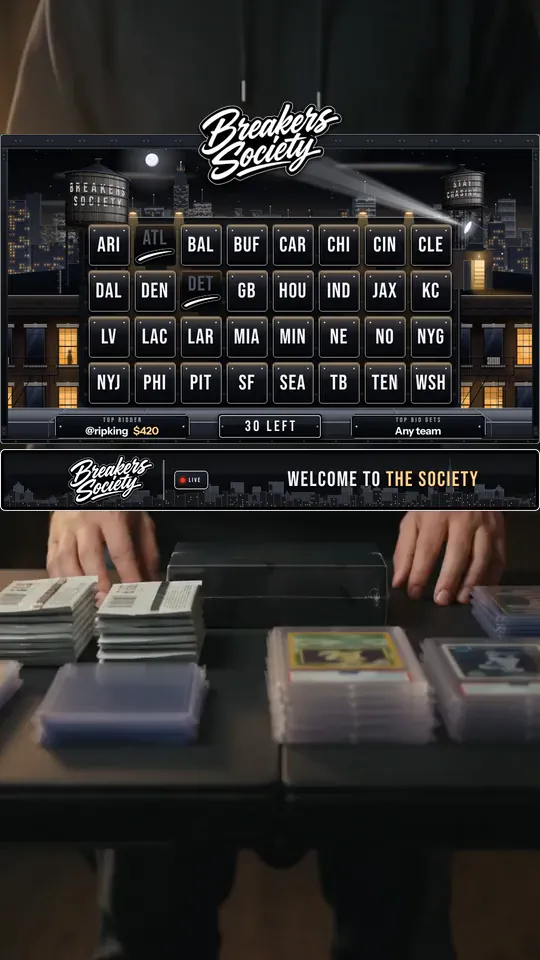
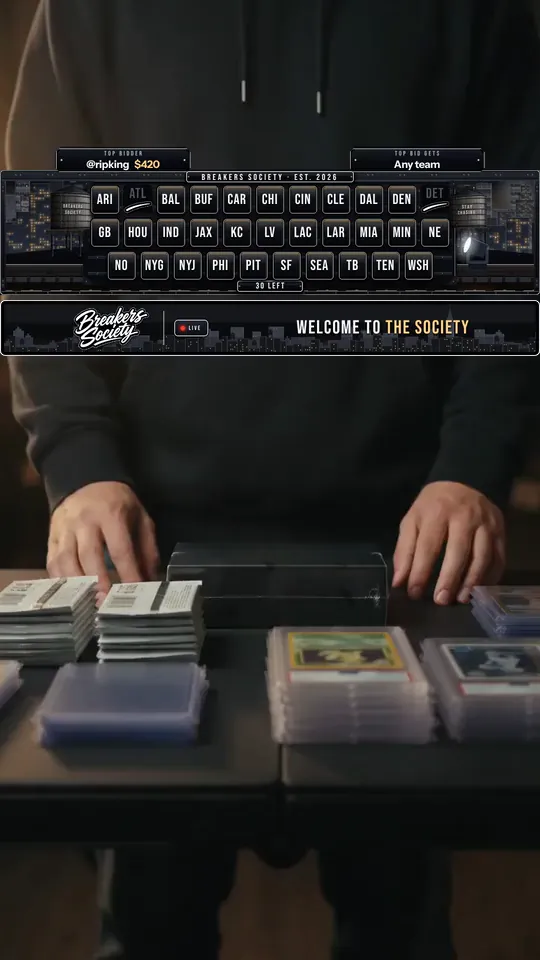
The same steps work for divisional breaks, number breaks and hit drafts. Which formats you can sell depends on the platform; see Whatnot break formats and break boards on eBay Live and other platforms.
What to check in any break board
- Phone screens. Whatnot streams are vertical and many viewers watch on a phone, with buttons and chat over parts of the picture. Codes have to read at that size, long usernames have to fit, and the board has to sit clear of the app’s buttons (Whatnot’s safe zones).
- Speed. Marking a spot should take a click or two, or the board falls behind the sales.
- Finding a buyer. During the rip, anyone should be able to see who owns a team at a glance.
- Mistakes. A spot on the wrong buyer, a trade, a refund: you need to fix one spot without redoing the board on stream.
- Restarts. If the software or the computer restarts mid-break, the sold spots have to come back (how to keep a break board running in OBS).
- Big breaks. Fifty or a hundred numbered spots need paging or a layout that stays readable.
- Changes. When you add a format, a sponsor or a new look, who makes the change, how fast, and at what cost?
Break board rules on Whatnot, eBay Live and TikTok Shop
- It must never pick winners. A board shows results; it never decides them. As of November 2026, Whatnot’s Card Breaks Policy bans randomizer wheels of any kind, including digital wheels run through third-party websites and streaming software (Whatnot randomizer wheel rules). eBay Live’s policy bans raffles and random drawings, and breaks there are limited to sellers eBay has approved (break boards on eBay Live and other platforms).
- It must never cover the product. Whatnot requires the product, tools and your hands to stay on screen through the whole break, and eBay Live requires the cards to stay clearly visible while they’re opened. The board has to leave room for your hands.
- It must never promise a prize. Saying what the winning bid buys is fine: “top bid gets any team” describes the spot itself. Adding something on top isn’t. Whatnot’s Card Breaks Policy says sellers can’t include a prize in a break, and Whatnot’s Gambling and Purchase-Based Prize Policy bans paid bounties and bonus items tied to outcomes, like an extra box of cards if someone pulls a holographic card. Chasers and hits can go on the board, but never as a reward.
TikTok Shop rewrote its break rules several times in 2026; since its 31 August policy update it allows random team breaks only through its own Surprise Set feature (TikTok Shop Collectibles Requirements; SCCG, September 2026). Check its current policy before you break there.
Policy facts checked 10 November 2026: Whatnot Card Breaks Policy · Whatnot Gambling and Purchase-Based Prize Policy · Whatnot Breaks feature · Whatnot Community Guidelines · Whatnot screen sharing · eBay Live policy
Break board options: free, DIY, template, app or custom
| Option | Cost | Good for | Trade-off |
|---|---|---|---|
| Whiteboard or printed sheet on camera | Free | Starting out, or streaming from a phone | Updated by hand; small on a phone screen |
| Whatnot’s spot list (Breaks feature) | Free | Every Whatnot breaker, with or without a board | Only buyers who open it see it; nothing on your video |
| Spreadsheet or Google Sheet in OBS | Free | Breakers on OBS who want something free today | Looks like a spreadsheet; you build and maintain it |
| Your own design (Canva or similar, added to OBS) | Free or low | Breakers who like to design | You update it by hand, image by image |
| Template | Paid once; about $80 to $110 per item (a board, an animation and so on) | A finished look without designing it yourself | Often graphics only: you update spots by hand in OBS. You set it up and maintain it, and other sellers may use the same design |
| Board app or tool | About $15 to $30 a month | Low upfront cost, changes you make yourself, ongoing updates | Ongoing fee; other sellers can use the same themes |
| Custom-built board | Paid once; about $500 to $5,000 or more | A one-of-a-kind board and animations, set up for you | You wait for the build, and later changes go through the designer |
How to weigh them: how to choose a break board.
Disclosure: BreakerStudio, which publishes this guide, builds custom break boards. As of November 2026, a BreakerStudio board is $799 once and yours to keep, with custom break animations, stream scenes, a control panel and a year of updates included. After the first year, updates are $99 a year and renew automatically until you turn them off; you keep your board either way. We’ll make you a free preview first.
Quick answers
Does Whatnot have a built-in break board?
Whatnot has no built-in break board on your video. Its Breaks feature gives buyers a spot list inside the app and can assign teams in random team breaks, but it puts no graphic on your stream. A break board shows the same break on the video, and the two work together (how Whatnot’s Breaks feature and your board work together).
Can I use a break board from my phone on Whatnot?
You can’t lay a break board over your camera from the Whatnot phone app; that needs streaming software such as OBS on a computer. If you host from your phone, Whatnot’s screen share can show a board running on a computer as a second view, but not on top of your camera (Whatnot: sharing your computer screen during a livestream).
Can a break board randomize teams on Whatnot?
Not with any method Whatnot documents. As of November 2026, Whatnot’s Card Breaks Policy bans digital randomizer wheels run in streaming software, so a break board only shows the team Whatnot’s randomizer or a physical randomizer such as a deck of cards assigned (Whatnot randomizer wheel rules).
Can you put team logos on a break board?
Not safely without permission. Team and league logos are trademarks, so showing them on a commercial stream is a rights question, not only a design choice. Whatnot’s Community Guidelines say sellers may not use another’s intellectual property, such as images or video, without authorization, and eBay Live only allows images you own or have written consent to use. Many break boards use short team codes (PHI, LAD, KC) in generic colors instead, which is the lower-risk choice. This isn’t legal advice.
What is a mid bar?
A mid bar is a strip across the middle of a card break stream, under the break board, that rotates messages such as the break name, rules, shipping, a follow prompt, socials or a QR code. Where a stream has one, it usually stays on screen for the whole show, including while the packs are opened and the board is hidden. It isn’t a sports-scores ticker.
How much does a break board cost?
A break board can be free: a whiteboard on camera, Whatnot’s in-app spot list, a spreadsheet in OBS or your own design. As of November 2026, templates cost about $80 to $110 per item, board apps about $15 to $30 a month, and custom-built boards about $500 to $5,000 or more, depending on features, animations and leagues. More in what a break board costs.
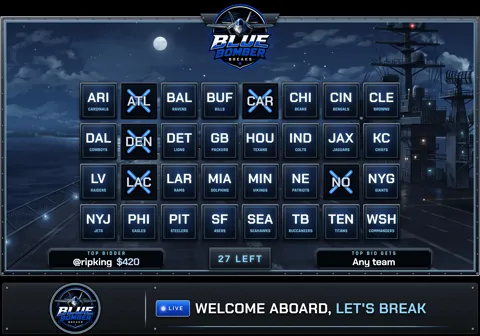 How to choose a break board
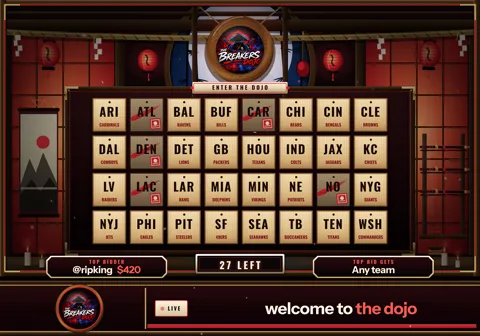 How much does a break board cost?
 How to set up OBS for Whatnot
 Can you use a randomizer wheel on Whatnot?